...
Days
Hours
Minutes
Seconds

left to register for ESG BEACON – The Premier Annual Event for AI-Powered End-to-End Solutions. Register Now

Streamline Your CSRD Compliance with Lythouse

The Ultimate Solution for Comprehensive and Efficient Sustainability Reporting

Understanding CSRD Compliance

Effective from 2024, the Corporate Sustainability Reporting Directive (CSRD) mandates EU companies to disclose detailed environmental, social, and governance (ESG) information with the same scrutiny as financial data.

The CSRD enhances transparency, accountability, and comparability in business practices, fostering sustainable investments. By promoting comprehensive ESG disclosures, it supports corporate sustainability, driving longterm value creation and stakeholder trust.

Check Your CSRD Compliance and Timeline

CSRD compliance mandates nearly 50,000 global companies to report on over 1,100 data points, including Scope 3 emissions, with specific timelines for different entities.

Public-interest enterprises
subject to NFRD

EU and Non-EU Large companies listed on EU markets, subject to NFRD, that meet the criteria:
  • More than 500 employees.
  • Turnover of €50M+.
  • Balance sheet of over €25M.

Report on financial year 2024 data to be published during calendar year 2025.

EU Large companies

Listed and Non-Listed EU Large companies that meet two of the following criteria:
  • More than 250 employees.
  • Turnover of €50M+.
  • Balance sheet of over €25M.

Report on financial year 2025 data to be published during calendar year 2026.

Listed EU SMEs

Listed SMEs (excluding micro companies) that meet two of the following criteria:
  • More than 50 employees.
  • Turnover of €900K+.
  • Balance sheet of over €450K.

Report on financial year 2026 data to be published during calendar year 2027.

Large companies
(Non-EU )

Non-EU companies with securities listed on EU regulated market that meet the criteria:
  • EU generated turnover of €150M+.
  • A branch in the EU generating more than €40M.

Report on financial year 2028 data to be published during calendar year 2029.

Note: SMEs may opt-out of CSRD application for two years, exempting them from publishing CSRD disclosures until 2029.

ESRS Data Requirements for CSRD Compliance

The European Sustainability Reporting Standards (ESRS) are guidelines under the CSRD for reporting on environmental, social, and governance (ESG) impacts to ensure transparency and comparability.

ESRS 1

Outlines the general principles for sustainability reporting, ensuring that reports are comprehensive, reliable, and comparable by covering the foundational concepts such as
Double materiality assessment
Sustainability due diligence
Supply and value chain
Timeline

ESRS 2

Sets the general disclosure requirements for companies across all sectors and serves as the foundation for sector-specific and topical standards focusing on
Governance: Governance Disclosure Requirements Governance 1-5
Strategy: SBM 1-3
Impacts, risks and opportunities – IRO 1-2 (based on Double Materiality Assessment)
Metrics and targets

ESRS Data Requirements for CSRD Compliance

The European Sustainability Reporting Standards (ESRS) are guidelines under the CSRD for reporting on environmental, social, and governance (ESG) impacts to ensure transparency and comparability.

ESRS 1

Outlines the general principles for sustainability reporting, ensuring that reports are comprehensive, reliable, and comparable by covering the foundational concepts such as

Double materiality
assessment


Sustainability due diligence


Supply and value chain


Timeline

ESRS 2

Sets the general disclosure requirements for companies across all sectors and serves as the foundation for sector-specific and topical standards focusing on

Governance 1-5 Disclosure


Strategy: SBM 1-3


Impacts, risks and
opportunities - IRO 1-2


Metrics and targets

To ensure transparency and accountability ESG within ESRS is categorized as follows:
Environmental (E) Standards: Includes stopics such as climate change (ESRS E1), pollution (ESRS E2), water and marine resources (ESRS E3), biodiversity and ecosystems (ESRS E4), and resource use and circular economy (ESRS E5).
Social (S) Standards: Covers areas related to the workforce (ESRS S1), workers in the value chain (ESRS S2), affected communities (ESRS S3), and consumers and end-users (ESRS S4).
Governance (G) Standards: Focuses on governance structures, including governance, risk management, and internal control (ESRS G1).

Effortlessly Navigate CSRD Compliance with Lythouse

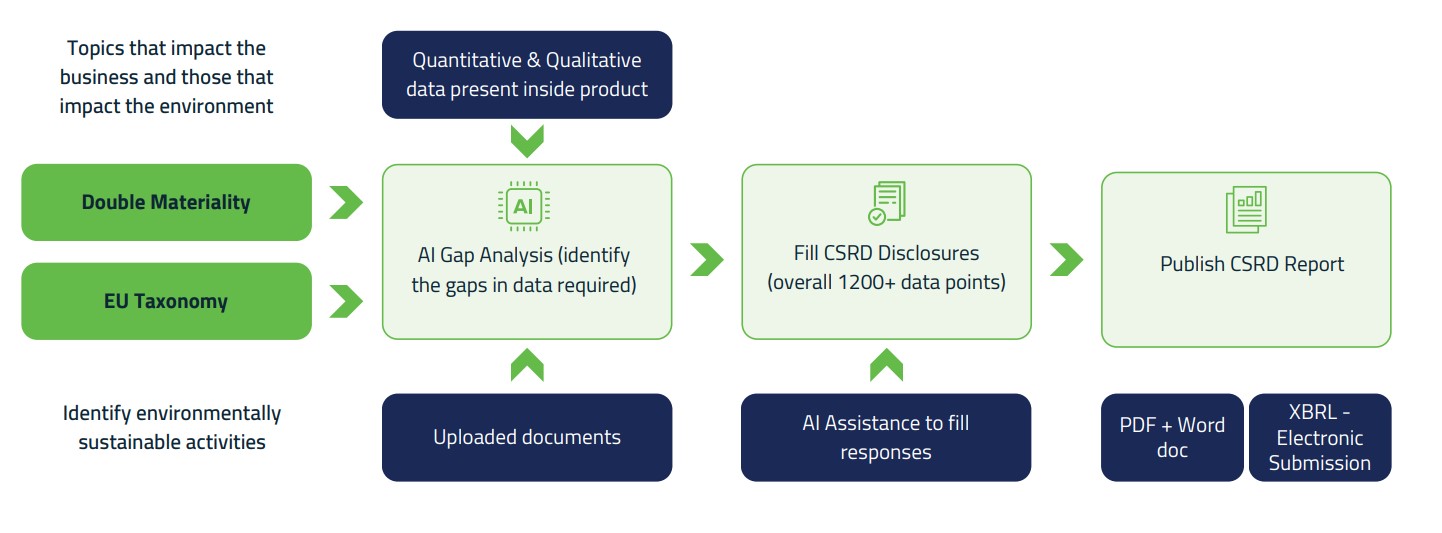
Lythouse streamlines your CSRD reporting journey with specialized tools for double materiality, EU taxonomy integration, automated data handling, and detailed audit workflows.
Topics that impact the business and those that impact the environment

Double Materiality

EU Taxonomy

Identify environmentally sustainable activities

Quantitative & Qualitative data present inside product

AI Gap Analysis (identify the gaps in data required)

Double Materiality

Fill CSRD Disclosures (overall 1200+ data points)

AI Assistance to fill responses

Publish CSRD
Report

PDF + Word doc

XBRL - Electronic Submission
Make Informed Decisions with Double Materiality

Make Informed Decisions with Double Materiality
Double materiality assesses both financial and non-financial impacts of a company’s activities, as required by CSRD.

Lythouse simplifies this by identifying key sustainable topics, auto-selecting relevant issues, and integrating these results into your CSRD report. This approach ensures comprehensive, compliant disclosures, streamlining ESG reporting under CSRD.

Ensure Sustainable Investments with EU Taxonomy

The EU Taxonomy defines sustainable economic activities to support EU climate goals and enhance transparency. Integrated with CSRD, it requires companies to disclose alignment with sustainability criteria.
Lythouse simplifies this by identifying the share of economically sustainable and non sustainable activities in capital expenditure, operational expenditure, and turnover, ensuring precise and comprehensive CSRD reporting.
EU Taonomy Product SS

Intelligent ESG Data Management and Gap Analysis

Seamlessly connect your existing systems (CRM, ERP, HR) to gather data on spending, consumption, travel, and more. Utilize Merlin AI to perform detailed gap analysis on the collected data, scanning for missing information and auto-populating it to ensure precise, comprehensive, and CSRD-compliant reporting.

Advanced Approval Workflows and Audit Trails

Advaanced Approval Workflows and Audit Trails
Data Validation

Data Validation

Implement configurable approval workflows, with POCs reviewing and approving data before audits.

Audit Trails

Audit Trails

Ensure complete traceability by recording every action and modification, supporting all types of audits.

Export Capabilities

Export Capabilities

Seamlessly export reports to DOC and XBRL formats for easy sharing and regulatory submission.